Saturday, 9 February 2013

Phone blows up with nagios alerts during lunch

For Wayne

Sent to you via Google Reader

Phone blows up with nagios alerts during lunch


Submitted by @pearcec


[ iMoo 2 ]

Friday, 8 February 2013

FedEx Bandwidth

FedEx Bandwidth:

FedEx Bandwidth


When - if ever - will the bandwidth of the Internet surpass that of FedEx?

—Johan Öbrink

Never underestimate the bandwidth of a station wagon full of tapes hurtling down the highway.

—Andrew Tanenbaum, 1981

2040.

If you want to transfer a few hundred gigabytes of data, it’s generally faster to FedEx a hard drive than to send the files over the internet. This isn’t a new idea—it’s often dubbed SneakerNet—and it’s how Google transfers large amounts of data internally.

But will it always be faster?

Cisco estimates that total internet traffic currently averages 167 terabits per second. FedEx has a fleet of 654 aircraft with a lift capacity of 26.5 million pounds daily. A solid-state laptop drive weighs about 78 grams and can hold up to a terabyte.

That means FedEx is capable of transferring 150 exabytes of data per day, or 14 petabits per second—almost a hundred times the current throughput of the internet.

gifs of animals falling off of things, volume 1

If you don’t care about cost, this ten-kilogram shoebox can hold a lot of internet

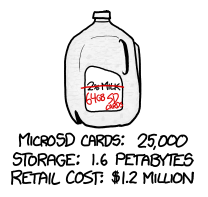
We can improve the data density even further by using MicroSD cards:

glug glug glug glug

Those thumbnail-sized flakes have a storage density of up to 160 terabytes per kilogram, which means a FedEx fleet loaded with MicroSD cards could transfer about 177 petabits per second, or two zettabytes per day—a thousand times the internet’s current traffic level. (The infrastructure would be interesting—Google would need to build huge warehouses to hold a massive card-processing operation.)

Cisco estimates internet traffic is growing at about 29% annually. At that rate, we’d hit the FedEx point in 2040. Of course, the amount of data we can fit on a drive will have gone up by then, too. The only way to actually reach the FedEx point is if transfer rates grow much faster than storage rates. In an intuitive sense, this seems unlikely, since storage and transfer are fundamentally linked—all that data is coming from somewhere and going somewhere—but there’s no way to  predict usage patterns for sure.

While FedEx is big enough to keep up with the next few decades of actual usage, there’s no technological reason we can’t build a connection that beats them on bandwidth. There are experimental fiber clusters that can handle over a petabit per second. A cluster of 200 of those would beat FedEx.

If you recruited the entire US freight industry to move SD cards for you, the throughput would be on the order of 500 exabits—half a zettabit—per second. To match that transfer rate digitally, you’d need take half a million of those petabit cables.

So the bottom line is that for raw bandwidth, the internet will probably never beat SneakerNet. Of course, the virtually infinite bandwidth would come at the cost of 80,000,000-millisecond ping times.

1000ms of lag lets you dodge shots; 100000000 lets you win a game, play through a whole tournaments, and build and maintain quality friendships before they have a chance to react

Saturday, 2 February 2013

Tuesday, 22 January 2013

Spent Fuel Pool

Spent Fuel Pool:

Spent Fuel Pool


What if I took a swim in a typical spent nuclear fuel pool? Would I need to dive to actually experience a fatal amount of radiation? How long could I stay safely at the surface?

—Jonathan Bastien-Filiatrault

Assuming you’re a reasonably good swimmer, you could probably survive treading water anywhere from 10 to 40 hours. At that point, you would black out from fatigue and drown. This is also true for a pool without nuclear fuel in the bottom.

Spent fuel from nuclear reactors is highly radioactive. Water is good for both radiation shielding and cooling, so fuel is stored at the bottom of pools for a couple decades until it’s inert enough to be moved into dry casks. We haven’t really agreed on where to put those dry casks yet. One of these days we should probably figure that out.

Here’s the geometry of a typical fuel storage pool:
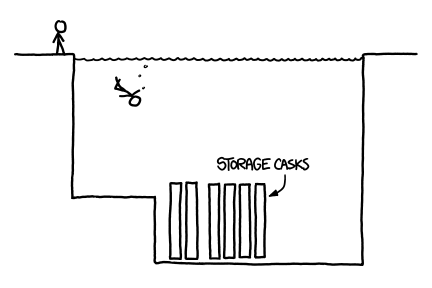
the geometry of a spent fuel pool

The heat wouldn't be a big problem. The water temperature in a fuel pool can in theory go as high as 50°C, but in practice they're generally between 25°C and 35°C—warmer than most pools but cooler than a hot tub.

For the kinds of radiation coming off spent nuclear fuel, every 7 centimeters of water cuts the amount of radiation in half.

The most highly radioactive fuel rods are those recently removed from a reactor. Based on the activity levels provided by Ontario Hydro in this report, this would be the region of danger for fresh fuel rods:
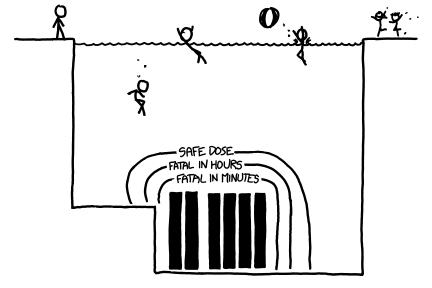
a diagram shows the parts of a spent fuel pool which you should not swim in

Swimming to the bottom, touching your elbows to a fresh fuel canister, and immediately swimming back up would probably be enough to kill you.

Yet outside the outer boundary, you could swim around as long as you wanted—the dose from the core would be less than the normal background dose you get walking around. In fact, as long as you were underwater, you would be shielded from most of that normal background dose. You may actually receive a lower dose of radiation treading water in a spent fuel pool than walking around on the street.
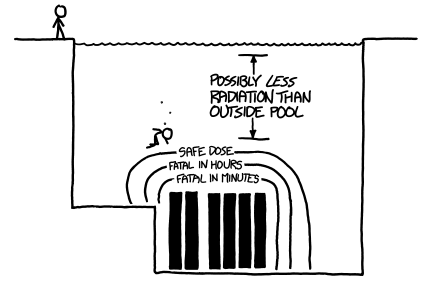
disclaimer: i am a cartoonist. if you follow my advice on safety around nuclear materials you probably deserve whatever happens to you.

That’s if everything goes as planned. If there’s corrosion in the spent fuel rod casings, there may be some fission products in the water. They do a pretty good job of keeping the water clean, and it wouldn’t hurt you to swim in it, but it’s radioactive enough that it wouldn’t be legal to sell it as bottled water. (Which is too bad—it’d make a hell of an energy drink).

We know spent fuel pools can be safe to swim in because they’re routinely serviced by human divers.


However, these divers have to be careful.

On August 31st, 2010, a diver was servicing the spent fuel pool at the Leibstadt nuclear reactor in Switzerland. He spotted an unidentified length of tubing on the bottom of the pool and radioed his supervisor to ask what to do. He was told to put it in his tool basket, which he did. Due to bubble noise in the pool, he didn’t hear his radiation alarm.

When the tool basket was lifted from the water, the room’s radiation alarms went off. The basket was dropped back in the water and the diver left the pool. The diver’s dosimeter badges showed that he’d received a higher-than-normal whole-body dose, and the dose in his right hand was extremely high.

The object turned out to be protective tubing from a radiation monitor in the reactor core, made highly radioactive by neutron flux. It had been accidentally sheared off while a capsule was being closed in 2006. It sank to a remote corner of the pool floor, where it sat unnoticed for four years.

The tubing was so radioactive that if he’d tucked it into a tool belt or shoulder bag, where it sat close to his body, he could’ve been killed. As it was, the water protected him, and only his hand—a body part more resistant to radiation than the delicate internal organs—received a heavy dose.

the most ominous edible arrangements basket ever

So, as far as swimming safety goes, the bottom line is that you’d probably be ok, as long as you didn’t dive to the bottom or pick up anything strange.

But just to be sure, I got in touch with a friend of mine who works at a research reactor, and asked him what he thought would happen to you if you tried to swim in their radiation containment pool.

“In our reactor?” He thought about it for a moment. “You’d die pretty quickly, before reaching the water, from gunshot wounds.”


Monday, 21 January 2013

Sunday, 13 January 2013

January 12, 2013


Sent to you via Google Reader

January 12, 2013


Hey geeks! James and Marque's kickstarter cooking show has just 3 more days.


And here's a message from our beloved dictator, Lord Ashby:


"SUPERPALS! We've raised over $10,000 for Marque's new show HAND TO MOUTH! THANK YOU ALL SO MUCH! But don't stop now! We have THREE DAYS LEFT to make the best possible version of Hand To Mouth we can! Come help us out and ask us questions during our LIVE BROADCASTS streaming from Marque, Jon, and James' new channel: BROKE EATS. We start at Noon PST this Saturday and have events planned all weekend! Cool kids are subscribing BEFORE there's new content to watch."


[ iMoo 2 ]