[ iMoo 2 ]
Saturday, 21 December 2013
Buttersafe » Santa Claus’ Santa Magic [feedly]
[ iMoo 2 ]
Our development model [feedly]

image by Mark
[ iMoo 2 ]
Friday, 6 December 2013
Thursday, 28 November 2013
Wednesday, 27 November 2013
Thursday, 14 November 2013
Monday, 28 October 2013
Pre-coffee deploy [feedly]
[ iMoo 2 ]
Wednesday, 25 September 2013
Thursday, 19 September 2013
Google's Datacenters on Punch Cards [feedly]
[ iMoo 2 ]
Friday, 13 September 2013
Wednesday, 28 August 2013
Demoing the product for the first time [feedly]
by trajektoor
[ iMoo 2 ]
Friday, 23 August 2013
Development vs Engineering vs Management [feedly]
Ha
by andrei
[ iMoo 2 ]
Wednesday, 7 August 2013
Thursday, 25 July 2013
Ctrl+Alt+Del: The Console War of 2013 p4 [feedly]
[ iMoo 2 ]
Sunday, 21 July 2013
How our drills look like [feedly]
image by Yoni
[ iMoo 2 ]
Wednesday, 19 June 2013
Monday, 17 June 2013
Lots of alerts - then realise it's dev environment [feedly]
by ADWynne
[ iMoo 2 ]
Sunday, 9 June 2013
Turtle Helps Another Turtle Out [feedly]
[ iMoo 2 ]
Sunday, 2 June 2013
Buttersafe » Spiders In Your Mouth [feedly]
[ iMoo 2 ]
Using unorthodox tricks (a.k.a. hacking) [feedly]
image by gram
[ iMoo 2 ]
Tuesday, 7 May 2013
High Throw [feedly]
High Throw
How high can a human throw something?
—Irish Dave on the Isle of Man
Humans are good at throwing things. In fact, we're great at it; no other animal can throw stuff like we can.
It's true that chimpanzees hurl feces (and, on rare occasions, stones), but they're not nearly as accurate or precise as humans.[1][2] Antlions throw sand, but they don't aim it. Archerfish hunt insects by throwing water droplets, but they use specialized mouths instead of arms. Horned lizards shoot jets of blood from their eyes for distances of up to five feet. I don't know why they do this because whenever I reach the phrase "shoot jets of blood from their eyes" in an article I just stop there and stare at it until I need to lie down.

So while there are other animals that use projectiles, we're just about the only animal that can grab a random object and reliably nail a target. In fact, we're so good at it that some researchers have suggested rock-throwing played a central role in the evolution of the modern human brain.[3][4]
Throwing is hard. In order to deliver a baseball to a batter, a pitcher has to release the ball at exactly the right point in the throw. A timing error of half a millisecond in either direction is enough to cause the ball to miss the strike zone.[5]
To put that in perspective, it takes about five milliseconds for the fastest nerve impulse to travel the length of the arm.[6] That means that when your arm is still rotating toward the correct position, the signal to release the ball is already at your wrist. In terms of timing, this is like a drummer dropping a drumstick from the 10th story and hitting a drum on the ground on the correct beat.
We seem to be much better at throwing things forward than throwing them upward. Since we're going for maximum height, we could use projectiles that curve upward when you throw them forward; the Aerobie Orbiters I had when I was a kid often got stuck in the highest treetops. But we could also sidestep the whole problem by using a device like this one:

It could be a springboard, a greased chute, or even a dangling sling—anything that redirects the object upward without adding to—or subtracting from—its speed. Of course, we could also try this:

But the deflector box seems easier.
I ran through the basic aerodynamic calculations for a baseball thrown at various speeds. I will give these in units of giraffes:

The average person can probably throw a baseball at least three giraffes high:

Someone with a reasonably good arm could manage five:

A pitcher with an 80 mph fastball could manage ten giraffes:

Aroldis Chapman, the holder of the world record for fastest recorded pitch (105 mph), could in theory launch a baseball 14 giraffes high:

But what about projectiles other than a baseball? Obviously, with the aid of tools like slings, crossbows, or the curved xistera scoops in jai alai, we can launch projectiles much faster than that. But for this question, let's assume we stick to bare-handed throwing.
A baseball is probably not the ideal projectile, but it's hard to find speed data on other kinds of thrown objects. Fortunately, a British javelin thrower named Roald Bradstock held a random object throwing competition, in which he threw everything from dead fish to an actual kitchen sink. Bradstock's experience gives us a lot of useful data (and a lot of other data, too). In particular, it suggests a potentially superior projectile: A golf ball.
Few professional athletes have been recorded throwing golf balls. Fortunately, Bradstock has, and he claims a record throw (to first contact with the ground) of 170 yards.[7] This involved a running start, but even so, it's reason to think that a golf ball might work better than a baseball. It makes sense; the limiting factor in baseball pitches is the torque on the elbow, and the lighter golf ball might allow the pitching arm to move slightly faster.
The speed improvement from using a golf ball instead of a baseball would probably not be very large, but it seems plausible that a professional pitcher with some time to practice could throw a golf ball faster than a baseball.
If so, based on aerodynamic calculations, Aroldis Chapman could probably throw a golf ball about sixteen giraffes high:

This is probably about the maximum possible altitude for a thrown object.
… unless you count the technique by which any five-year-old can beat all these records easily:

[ iMoo 2 ]
Monday, 6 May 2013
Trying to fix someone else's CSS [feedly]
by Maciej
[ iMoo 2 ]
Friday, 3 May 2013
One Tired Ducky [feedly]
[ iMoo 2 ]
Testing interface on Internet Explorer [feedly]
by Gian
[ iMoo 2 ]
Thursday, 25 April 2013
When caffeine stops working [feedly]
by acid
[ iMoo 2 ]
Wednesday, 17 April 2013
QA's first look at new build [feedly]
by o4kapuk
[ iMoo 2 ]
Wednesday, 10 April 2013
Friday, 29 March 2013
Thursday, 28 February 2013
Sunday, 24 February 2013
Thursday, 21 February 2013
Thursday, 14 February 2013
Saturday, 9 February 2013
Cowboy Toad
Sent to you via Google Reader
Cowboy Toad
Cowboy Toad is the fastest fly wrangler in the whole wild west, and don't you forget it!
-Sally Squeeps
[ iMoo 2 ]
Phone blows up with nagios alerts during lunch
Sent to you via Google Reader
Phone blows up with nagios alerts during lunch

Submitted by @pearcec
[ iMoo 2 ]
Friday, 8 February 2013
FedEx Bandwidth
FedEx Bandwidth
When - if ever - will the bandwidth of the Internet surpass that of FedEx?
—Johan Öbrink
Never underestimate the bandwidth of a station wagon full of tapes hurtling down the highway.
—Andrew Tanenbaum, 1981
2040.
If you want to transfer a few hundred gigabytes of data, it’s generally faster to FedEx a hard drive than to send the files over the internet. This isn’t a new idea—it’s often dubbed SneakerNet—and it’s how Google transfers large amounts of data internally.
But will it always be faster?
Cisco estimates that total internet traffic currently averages 167 terabits per second. FedEx has a fleet of 654 aircraft with a lift capacity of 26.5 million pounds daily. A solid-state laptop drive weighs about 78 grams and can hold up to a terabyte.
That means FedEx is capable of transferring 150 exabytes of data per day, or 14 petabits per second—almost a hundred times the current throughput of the internet.

If you don’t care about cost, this ten-kilogram shoebox can hold a lot of internet
We can improve the data density even further by using MicroSD cards:

Those thumbnail-sized flakes have a storage density of up to 160 terabytes per kilogram, which means a FedEx fleet loaded with MicroSD cards could transfer about 177 petabits per second, or two zettabytes per day—a thousand times the internet’s current traffic level. (The infrastructure would be interesting—Google would need to build huge warehouses to hold a massive card-processing operation.)
Cisco estimates internet traffic is growing at about 29% annually. At that rate, we’d hit the FedEx point in 2040. Of course, the amount of data we can fit on a drive will have gone up by then, too. The only way to actually reach the FedEx point is if transfer rates grow much faster than storage rates. In an intuitive sense, this seems unlikely, since storage and transfer are fundamentally linked—all that data is coming from somewhere and going somewhere—but there’s no way to predict usage patterns for sure.
While FedEx is big enough to keep up with the next few decades of actual usage, there’s no technological reason we can’t build a connection that beats them on bandwidth. There are experimental fiber clusters that can handle over a petabit per second. A cluster of 200 of those would beat FedEx.
If you recruited the entire US freight industry to move SD cards for you, the throughput would be on the order of 500 exabits—half a zettabit—per second. To match that transfer rate digitally, you’d need take half a million of those petabit cables.
So the bottom line is that for raw bandwidth, the internet will probably never beat SneakerNet. Of course, the virtually infinite bandwidth would come at the cost of 80,000,000-millisecond ping times.
Monday, 4 February 2013
Saturday, 2 February 2013
Tuesday, 22 January 2013
Spent Fuel Pool
Spent Fuel Pool
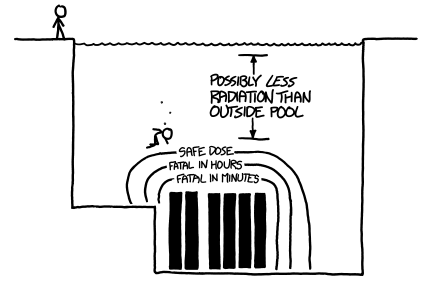
What if I took a swim in a typical spent nuclear fuel pool? Would I need to dive to actually experience a fatal amount of radiation? How long could I stay safely at the surface?
—Jonathan Bastien-Filiatrault
Assuming you’re a reasonably good swimmer, you could probably survive treading water anywhere from 10 to 40 hours. At that point, you would black out from fatigue and drown. This is also true for a pool without nuclear fuel in the bottom.
Spent fuel from nuclear reactors is highly radioactive. Water is good for both radiation shielding and cooling, so fuel is stored at the bottom of pools for a couple decades until it’s inert enough to be moved into dry casks. We haven’t really agreed on where to put those dry casks yet. One of these days we should probably figure that out.
Here’s the geometry of a typical fuel storage pool:

The heat wouldn't be a big problem. The water temperature in a fuel pool can in theory go as high as 50°C, but in practice they're generally between 25°C and 35°C—warmer than most pools but cooler than a hot tub.
For the kinds of radiation coming off spent nuclear fuel, every 7 centimeters of water cuts the amount of radiation in half.
The most highly radioactive fuel rods are those recently removed from a reactor. Based on the activity levels provided by Ontario Hydro in this report, this would be the region of danger for fresh fuel rods:

Swimming to the bottom, touching your elbows to a fresh fuel canister, and immediately swimming back up would probably be enough to kill you.
Yet outside the outer boundary, you could swim around as long as you wanted—the dose from the core would be less than the normal background dose you get walking around. In fact, as long as you were underwater, you would be shielded from most of that normal background dose. You may actually receive a lower dose of radiation treading water in a spent fuel pool than walking around on the street.

That’s if everything goes as planned. If there’s corrosion in the spent fuel rod casings, there may be some fission products in the water. They do a pretty good job of keeping the water clean, and it wouldn’t hurt you to swim in it, but it’s radioactive enough that it wouldn’t be legal to sell it as bottled water. (Which is too bad—it’d make a hell of an energy drink).
We know spent fuel pools can be safe to swim in because they’re routinely serviced by human divers.
However, these divers have to be careful.
On August 31st, 2010, a diver was servicing the spent fuel pool at the Leibstadt nuclear reactor in Switzerland. He spotted an unidentified length of tubing on the bottom of the pool and radioed his supervisor to ask what to do. He was told to put it in his tool basket, which he did. Due to bubble noise in the pool, he didn’t hear his radiation alarm.
When the tool basket was lifted from the water, the room’s radiation alarms went off. The basket was dropped back in the water and the diver left the pool. The diver’s dosimeter badges showed that he’d received a higher-than-normal whole-body dose, and the dose in his right hand was extremely high.
The object turned out to be protective tubing from a radiation monitor in the reactor core, made highly radioactive by neutron flux. It had been accidentally sheared off while a capsule was being closed in 2006. It sank to a remote corner of the pool floor, where it sat unnoticed for four years.
The tubing was so radioactive that if he’d tucked it into a tool belt or shoulder bag, where it sat close to his body, he could’ve been killed. As it was, the water protected him, and only his hand—a body part more resistant to radiation than the delicate internal organs—received a heavy dose.

So, as far as swimming safety goes, the bottom line is that you’d probably be ok, as long as you didn’t dive to the bottom or pick up anything strange.
But just to be sure, I got in touch with a friend of mine who works at a research reactor, and asked him what he thought would happen to you if you tried to swim in their radiation containment pool.
“In our reactor?” He thought about it for a moment. “You’d die pretty quickly, before reaching the water, from gunshot wounds.”
Monday, 21 January 2013
Sunday, 13 January 2013
January 12, 2013
Sent to you via Google Reader
January 12, 2013

Hey geeks! James and Marque's kickstarter cooking show has just 3 more days.

And here's a message from our beloved dictator, Lord Ashby:
"SUPERPALS! We've raised over $10,000 for Marque's new show HAND TO MOUTH! THANK YOU ALL SO MUCH! But don't stop now! We have THREE DAYS LEFT to make the best possible version of Hand To Mouth we can! Come help us out and ask us questions during our LIVE BROADCASTS streaming from Marque, Jon, and James' new channel: BROKE EATS. We start at Noon PST this Saturday and have events planned all weekend! Cool kids are subscribing BEFORE there's new content to watch."
[ iMoo 2 ]